3 Ways to Speed Up Your Hiring Process in a Competitive Market

WOW Recruitment

Competition for skilled candidates is, and always will be, high. Top-performers can come and go in the blink of an eye, and the efficiency of your hiring process may determine whether you get your pick of the best people or lose those coveted applicants to a competitor and struggle to fill critical roles. Not to mention that a lagging hiring process costs time and money that could be better spent elsewhere!


We all know that time is of the essence in the war for talent, so here are three effective strategies for speeding up your recruitment process to ensure you can secure the people you need, when you need them.
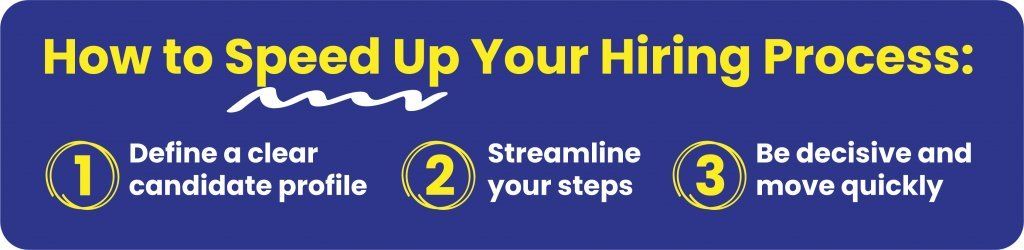
1. Define a Clear Candidate Profile


Step one for any employer is creating a clear candidate profile. What does your ‘perfect fit’ look like? A well-thought-out candidate profile is the foundation for all subsequent steps in the hiring process – start strong, end strong! Ensure your requirements are crystal clear, outlining everything from skills, competencies and experience to personality traits, work style and cultural fit.


If the perfect candidate profile hasn’t immediately sprung to mind, speaking to other leaders in the business could help you to put together a better picture. The other option is partnering with a specialist recruiter who can help you identify what’s crucial vs. ‘nice to have’ and steer you in the right direction with their industry experience.


With a strong profile as a guide, you will be able to quickly identify which candidates match your needs, faster.


2. Streamline Your Process


Step two is taking the time to think critically about where the bottlenecks in your hiring process are likely to be. Ask yourself these questions:


Have I set enough time aside to review candidate shortlists?


Can I combine multiple stages of the interview process together?


If I interview a great candidate how can I quickly get other decision-makers on board with my decision?


It will come as no shock that interviewing is one of the most time-consuming steps. Issues such as requiring several rounds of interviews or having to juggle the schedules of multiple interviewers can be sticking points that can cause significant delays. Being flexible with times and location, utilising phone/video interviews and conducting panel interviews are all great ways to optimise this part of the process.
3. Be Decisive


Once you find the right candidate, we recommend that you stop interviewing other prospective hires. Of course, it can be tempting to explore all possible options before making a decision, but in today’s market, the best people still have their pick of opportunities and delaying could mean missing out on your first choice leaving you back at square one.


It’s a good idea to be ready to extend an offer to your preferred candidate right away, ideally on the same day as the interview. And don’t forget to keep applicants (or your recruitment partner) in the loop about where they stand – if they think you’re not interested, they might move on to another employer. Moving quickly is a win-win for all parties; in doing so, you are not only raising your chances of securing your ideal candidate, but also allowing unsuccessful people to continue looking for a role that’s a better fit for them.


Summary


In recruitment, every day counts, and getting high performing people on board as quickly as possible is vital to any organisation’s success. By taking steps to shorten the timeline, you can make the final offer sooner and be in the best position to hire top people for your team.


Working with a recruiter is one of the easiest ways to speed up your hiring process – we’re specialists at keeping candidates engaged, ‘selling’ the benefits of your company, and overall just helping to make the process as efficient as possible – for all parties involved!


About WOW


Everything we do comes down to making everyone happier about recruitment. We know recruiting the very best people is critical for you. Get in touch or give us a buzz on 02 8320 0683 to get greater together.

By Eydie McLeod December 22, 2025
The Great Resignation put tremendous pressure on companies to attract and retain talent. And while that’s reduced to a great extent now, 55% of employers hired solely to replace departing employees in 2025. Moreover, 38% of employers still report difficulty in recruitment. Both these facts point to one thing: you need a robust recruitment strategy. It’s the key to ensuring business stability as it enables you to get the right talent when you need it. A common dilemma organisations face when building a recruitment strategy is that of choosing between in-house recruitment vs. outsourcing to an agency. Depending on your hiring volume, role complexity, and internal resources, either approach could work. But let’s take a look at them in detail to understand which one is right for you. Cost-Effectiveness Which method works out better for your finances? Lower recruitment costs can help you free up funds for growth and increase profitability. Let’s see how each method stacks up in this regard. In-house Recruitment The costs associated with in-house recruitment majorly comprise of: Staff salaries and benefits Recruitment tools and job board subscriptions Advertising and marketing expenses Onboarding and training costs These are the more “visible” costs, but there are some hidden ones that can increase the impact on your bottom line, such as: Time investment by hiring managers and interviewers Opportunity cost of a vacancy Cost of a bad hire Overworked existing employees until a vacancy is filled That said, in-house recruitment costs don’t come upfront, but add up over time. Also, certain costs like salaries are fixed annual expenses. They could quickly turn into financial drains during periods of low growth. So, it makes sense to opt for this approach only if you have high-volume hiring needs. Recruitment Agency When you opt for a recruitment agency, the upfront costs could be slightly higher as an agency would typically charge a percentage fee of the candidate’s first-year annual salary. Some agencies work on a fixed-fee model as well, where you pay the pre-decided amount on a successful hire. Unlike an in-house setup, you don’t have any recurring costs here. You pay only for a successful outcome, effectively outsourcing the financial risk of the search. Furthermore, recruitment specialists operate as well-oiled machines. Because they focus exclusively on talent acquisition, these firms often possess a deeper understanding of executive requirements and niche markets than a generalist HR team could maintain. Verdict The per-hire costs of in-house recruitment can be lower if you’ve got higher volumes. However, for specialised and one-off hires, agencies provide superior value. The premium demanded by agencies often reflects their market expertise and faster placement outcomes, which result in invisible cost savings. By opting for a fixed-fee or percentage model, you hand over the administrative burden to the agency, freeing you up to focus on other, more pressing matters. Access to Talent - Active vs. Passive Candidate Pools Talent that’s the right fit for your role is out there. But what’s the best way of reaching it? Which method does a better job? In-house Recruitment In-house recruitment teams heavily rely on job boards, ads, and inbound applications for finding the right candidates. These are active candidate pools that include individuals who are actively looking for jobs by searching and applying for them. While effective for junior roles, this approach misses the passive market: high-performing professionals who aren't looking but are willing to move for the right opportunity. That said, in-house teams do get the opportunity to form their own talent pools by connecting with candidates and building relationships with them even before they have new job openings. Recruitment Agency Here at WOW Recruitment, you gain access to both active and passive talent pools. Since they’re solely focused on recruitment, agencies are able to tap into passive candidates through the strong networks they’ve built over the years. This proactive approach comes in handy, especially when you’re looking for niche and senior hires. You gain access to pools that are otherwise out of your in-house team’s reach. For mission-critical or confidential roles where public advertising is a risk, an agency provides the necessary layer of anonymity while still ensuring a robust shortlist. Verdict Recruitment agencies give you access to a much larger candidate pool. You can rely on their existing network to even hire for confidential roles. In-house teams don’t have that edge, but can build it over time. Time-to-Hire and Business Continuity Leaving a position vacant for too long is a risk. Case in point – delayed hiring cycles negatively impact 92% of businesses , often stalling projects and damaging team morale. Here’s how each method fares in this regard: In-house Recruitment In-house teams juggle a broad spectrum of responsibilities, from payroll and compensation to employee training. Recruitment is just one of the competing priorities here, inevitably leading to a longer time-to-hire. Additionally, the in-house team needs to build talent pools from scratch and also has to spend a lot more time on internal alignment. They may sometimes lack the right set of tools to execute their hiring tasks efficiently too. Learn More: 3 Ways to Speed Up Your Hiring Process | WOW Recruitment Recruitment Agency Unlike in-house teams, recruitment agencies are solely focused on finding the right candidate for your business. By using tried-and-tested processes, they can easily discover candidates, tapping into their existing talent pools. They also possess the right tech stack for a smooth end-to-end management of the recruitment campaign. Finally, agencies are motivated by speed as they are only paid for each successful hire. It naturally accelerates the hiring timeline. Verdict A shorter hiring time means your vacancies can be filled quickly with minimal disruption to your business, ensuring continuity. Recruitment agencies can help you fill the vacancies faster than in-house teams, making them a better option. That said, if you have a dedicated team for hiring and need to hire continuously, an in-house team should be your go-to strategy. Improve Your Hiring Outcomes Both in-house teams and recruitment agencies can help you power up your hiring campaigns. However, the right choice depends on your business context. It’s best to assess your hiring urgency, complexity, and internal capability before making a decision. If you’re looking for a shorter time-to-hire, want to keep things confidential, or need to fill executive positions, agencies are the better option. If you’re evaluating which method works better for your business, let’s talk. At WOW Recruitment, we make hiring talent (both permanent and temporary) seamless. Want to experience WOW? Contact us today.
By Emily Angeloni November 28, 2025
Technology now evolves faster than job descriptions, and candidate expectations shift with every quarter. Amid that pace, one thing remains constant: organisations that invest in their people with intention outperform those that don’t.
Defining ROI on Creativity
By Eydie McLeod, WOW Recruitment October 10, 2025
Discover how creativity drives ROI - from emotional impact to business value. Insights from top marketers on turning ideas into measurable success.
More Posts